

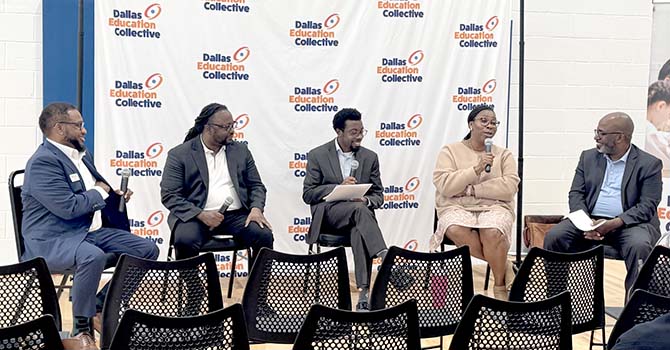
(The Dallas Examiner) – The Dallas Education Collective held the second of three planned community meetings on improving public schools in underserved areas. DEC, a nonprofit that works with community and education leaders to help close the education gap in underserved areas, gathered families, leaders in education and representatives from local nonprofit organizations to discuss school performance and the valuable resources that are available to families. The forum was held Sept. 23 at the Park South Family YMCA in South Dallas.
“Our belief and understanding is that no work, no change that is going to be sustained can happen without the community and those that we’re here to serve. So as a part of that, we want to hear from you,” Nakia Douglas, executive director of DEC said in his opening statement.
The forum began with a panel discussion moderated by Sienzhi Kouemo, project manager for the United Way of Dallas Community Impact Team and graduate of Barack Obama Male Leadership Academy in Cedar Crest. Panelists included the following:
- Dr. Summer Rose, CEO of Communities in Schools – Dallas region and a licensed psychologist.
- Ed Turner, Dallas ISD Board of Trustees – District 9
- Duane Reid, regional director of Year Up United workplace readiness organization.
Kouemo asked the panel to describe what parent and community engagement looks like to them. Turner’s response emphasized the importance of parents and guardians joining site-based decision making – or SBDM – groups. SBDM groups are made up of stakeholders who choose policies and procedures that are in the best interest of students.
“When you serve on the SBDM, you are at the decision-making table for holding that school accountable. And accountability is not a ‘Gotcha,’ it’s a ‘What can we do to improve,’” Turner said.
City government, businesses and industries can also play a role in the improvement of the student experience by creating pathways for young adults to achieve professional goals. Dallas ISD currently offers 16 different tracks through career institutes where students can graduate high school with a trade certification. When businesses partner with schools to connect with and hire students who are already skilled and certified, the community wins.
“Partnerships are pathways to changing the narrative,” Reid said.
Reid added that while schools teach professional skills and award certifications, not enough emphasis is placed on soft skills such as teamwork, adaptability and conflict resolution, which are vital for navigating any career.
“The old adage is that they hire for skills, but they fire for behavior,” Reid said. “Teaching those skills costs, and a lot of the time schools don’t have the money to pay for them – make sure resources are where they’re needed. These skills should be as important as math, science and reading.”
The community Q&A portion of the meeting turned to a topic that has drawn increased attention when it comes to students – mental health. Students oftentimes have internal challenges with their mental health as well as challenges caused by stressors in their social lives or at home. Parents and guardians may be unaware of the resources that are available to support their child’s mental health.
“I have the pleasure of being a part of an organization that partners with schools to have trained staff that are on campus every day,” Rose said of Communities in Schools. “Parents don’t have to miss work, and students don’t have to miss a lot of school for appointments with a mental health professional.”
Parents and guardians must, however, give the proper authorization for school staff to provide treatment to their child.
“Your kid can be at school, need something that we can provide, and be told ‘no’ because the adults didn’t check the box and sign off. It used to be that you could opt-out, but now you actually have to opt-in,” Rose said.
The mission of DEC is to significantly improve public education in the areas of greatest need.
Douglas explained that it requires an entire ecosystem to fuel the success of students and schools. That ecosystem includes parents, families, professionals and the community.
“Public education is changing throughout our city, and it doesn’t happen just by one individual. It happens collectively. We need to know how we can best engage with our campuses and guide them to the excellence that we want to see for all children throughout our city,” Douglas said.
Students and families had an opportunity after the Q&A session to speak with representatives from several organizations to learn how they may be able to benefit from resources offered by the organizations. Other organizations at the forum included Toast for Charity, which provides scholarships, mentorship and educational support; Carter’s House, which offers reduced-priced school uniforms and other clothing to students and families in need; and the GEMS Camp, which aims to close the gender and racial gap in STEM education by building a community around educating and mentoring girls of color.
The next community forum will be held Oct. 21 at 5:30 p.m. at the Pleasant Oaks Recreation Center. To register, visit https://www.rsvptexas.com/DEC/.