

Global Information Network
(TriceEdneyWire.com) – The passing of Queen Elizabeth II has not gone unremarked in Africa. Television and radio stations across the country interrupted normal broadcasting in order to relay events happening in the United Kingdom.
Across the world, nations have been paying tribute to the 96-year-old monarch. President Joe Biden described her as “a stateswoman of unmatched dignity and constancy who deepened the bedrock alliance between the United Kingdom and the United States.”
The queen embodied a profound, sincere commitment to her duties, observed Harvard Professor Maya Jasanoff.
“She was a fixture of stability, and her death in already turbulent times will send ripples of sadness around the world,” she said.
But we should not romanticize her era, Jasanoff cautioned.
“For the queen was also an image: the face of a nation that, during the course of her reign, witnessed the dissolution of nearly the entire British Empire into some 50 independent states and significantly reduced global influence,” she added.
Britain “lost an empire, and [has] not yet found a role” commented American statesman Dean Acheson. The deep and painful traumas and confusions that the loss of empire produced helped many years later to produce Brexit and enduring and dangerous British fantasies about playing the role of a great power on the world stage.
Others have shown little sympathy for the fallen empire and demanded amends for colonial-era crimes. Carnegie Mellon professor Uju Anya had the sharpest criticism of the queen.
“If anyone expects me to express anything but disdain for the monarch who supervised a government that sponsored the genocide that massacred and displaced half my family and the consequences of which those alive today are still trying to overcome, you can keep wishing upon a star,” the Nigerian-born professor wrote.
Some addressed the systemic racism and colonialism surrounding the monarchy.
“I guess it depends what you think a good job of being queen is,” opined Birmingham City University Professor Kehinde Andrews of British African Caribbean heritage. “So, if a good job of being queen is to represent white supremacy and to represent that link to colonialism, then, yeah, I think she’s done a very good job.”
University of Cambridge professor Priya Gopal questioned how much has changed in Britain.
“Let us remember that when she became queen at Treetops [Hotel] in Kenya, Britain had just commenced a brutal, vicious insurgency that carried on for several years,” added University of Cambridge professor Priya Gopal. “In recent years, we have had Kenyans who were tortured by the British raise lawsuits, successfully in some cases, around the vicious violence of the British state at that point.
“I do wonder whether we actually live in a deeply different world. We live in a world where formally the British crown is no longer an imperial crown, but Elizabeth II was, in a sense, obsessed with the Commonwealth, made sure that Charles III would also be head of the Commonwealth.”
“I think, as Maya just suggested, much of that order has not changed.”
Gopal said she found herself appreciating the circumstances in which Elizabeth passed – good medical care, in a secure shelter in a place she loved. But how many British retirees would have the same easeful passing this winter?
She answered her own question.
“I think many will be in insecure housing, without heat, potentially without food and certainly without access to good medical care,” she stated.
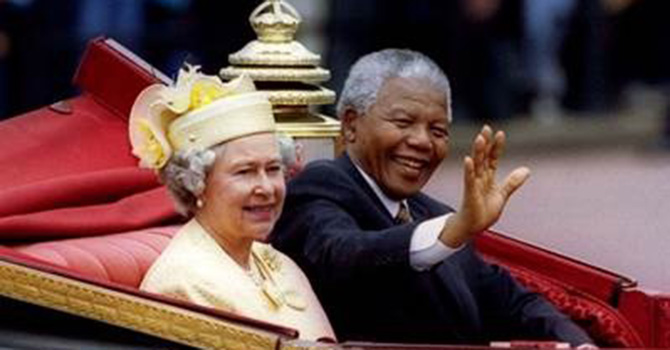
Amid the strait-laced protocols of the position, the queen enjoyed one rare privilege – a relationship on a first name basis with Nelson Mandela.
The exchanges between these two great figures were warm, recalls this statement of the Mandela Foundation.
“They spoke frequently on the phone, calling each other by their respective first names as a sign of mutual respect and affection,” said the statement issued the day after the British monarch died at 96.
“In the years following his release from prison, he cultivated a close bond with the Queen,” the text said. “He received her in South Africa and visited her in England, not shying away from exploring Buckingham Palace.”
Mandela also gave the queen the nickname, “Motlalepula” – meaning “come with the rain” – after a state visit in 1995, when she arrived with torrential rain, “the like of which had not been seen for a long time.” It is now a song by the world-renowned artist Hugh Masekela.
The foundation stated it “joins the multitude around the world in saying ‘hamba kahle’ –meaning go in peace – to the Queen.”