

(The Dallas Examiner) – Senators Rand Paul, R-Ky., and Cory Booker, D-N.J., reintroduced the Justice for Breonna Taylor Act, legislation to ban no-knock warrants in the U.S. Senate, Dec. 11 – along with co-sponsors Reps. Yvette D. Clarke, NY-09, and Jasmine Crockett, TX-30. Congressman Morgan McGarvey, KY-03, introduced companion legislation in the U.S. House of Representatives.
It was originally introduced by Paul and Booker March 11, 2021, and reintroduced three years later.
The bill is named in memory and honor of Breonna Taylor, a 26-year-old Black female EMT, who was fatally shot by officers Jonathan Mattingly, Brett Hankison and Myles Cosgrove of the Louisville Metro Police Department during a police raid on her home. The raid was conducted in March 2020 under the authority of a no-knock warrant, according to a media release.
The bill would require federal law enforcement officers to provide notice of their authority and purpose before they could execute a warrant, and it would require the same of any state or local law enforcement agency that receives funds from the Department of Justice.
Each year, the bill failed to pass.
No-knock dangers
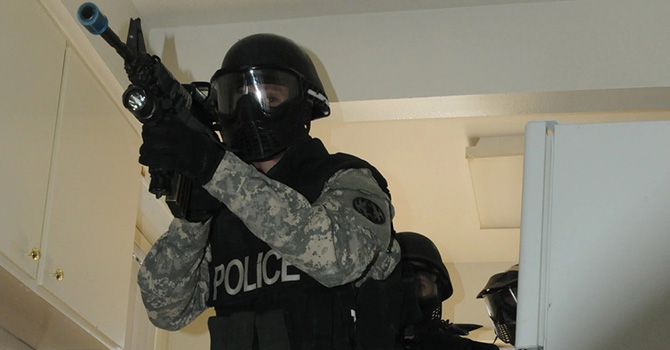
No-knock warrants began when President Richard Nixon launched a “war on drugs” in the 1970s. As it gained momentum, it became associated with police in militarized gear, according to the National Institutes of Health.
Each year, an estimated 20,000 to 80,000 no-knock warrants are served across the nation. In roughly 50%, officers found no guns and 36% produced no illegal drugs, the Center for Justice Research noted in a study.
Reports have shown that the entry meant to be stealthy can also be dangerous for both household and agents. Since 2010, there have been seven deaths and 46 injuries related to no-knock warrants, according to a report by the American Civil Liberties Union.
The report revealed a 2014 incident where SWAT carried out a no-knock warrant at 3 a.m. for a Georgia man suspected of being a violent drug dealer. One officer threw a flash bang through the door as the team prepared to rush into the home. It landed in a playpen where a 1-year-old boy was lying.
When attempting to run to her screaming baby – who she saw laying in a pool of blood with at least one rib exposed and singed – the mother was told to “sit down and shut up.” The search of the residence produced no guns or drugs and no arrest was made.
The toddler was taken to the hospital and admitted into the pediatric intensive care unit. He sustained third-degree burns to his face and chest and a deep wound that exposed part of his ribs. He was placed in a medically induced coma, fighting for his life. A month later, the toddler pulled through but was placed on hospital-based rehabilitation.
The boy has since recovered. He and his parents won a lawsuit and were awarded $3.6 million.
For justice and safety
Despite such incidents, bills to ban no-knock warrants have failed.
“It’s been more than five years since Breonna Taylor’s horrific death, and Congress has still failed to pass a public safety bill prohibiting no-knock entries at the federal level,” Booker said in statement to the media. “The Justice for Breonna Taylor Act is bipartisan, bicameral legislation that would ensure no one has to experience the terror of police barging into their home unannounced. Many cities and states, including Louisville, Kentucky, where Breonna was fatally shot, have already banned no-knock warrants. It’s past time we take federal action to ensure a tragedy like Breonna’s death never happens again.”
Though the bill has yet to pass, five states have banned no-knock warrants – Connecticut, Florida, Oregon, Tennessee and Virginia. While other states, like Maine and Utah have placed limits on when they can be issued. Louisville and Indianapolis have opted not to wait for state and federal legislation and have passed city-wide bands, the release stated.
“Kentucky recognized that no-knock warrants pose serious and unnecessary risks to both the public and law enforcement and wisely restricted their use. The federal government should follow Kentucky’s lead and ensure this high-risk tactic is constrained,” Paul said.
This year, the Congressional Black Caucus – who has repeatedly endorsed the bill – hoped the bill will pass and prevent a recurrence of the deadly incident.
“On March 13, 2020, the Louisville Police Department executed a no-knock warrant at the home of Breonna Taylor, ultimately ending her life by opening fire on her and her partner,” CBC chair Clarke wrote in a media release. “This tragedy should never have occurred, and Breonna Taylor should still be with us today. We continue to uplift the voice of her mother, Tamika Palmer, as she continues to fight for justice.”
The CBC called the incident a profound failure of the justice system and the U.S. is morally responsible for correcting it. Noting that the need for legislation to address the matter has intensified over the last few years, the group called for Congress to recognize that Americans have a right to live without fear that law enforcement could forcefully enter their home unannounced.
They further stated that parents, like Tamika Palmer, should not have to endure the grief of losing a child due to a system failure that could be fixed.
“Breonna Taylor’s life mattered, and her story demands action. It is our duty to ensure that what happened to her never happens again – to any family, in any community, anywhere in this country,” Clarke continued.
“The Congressional Black Caucus is calling on our colleagues to join our coalition and pass the Justice for Breonna Taylor Act to prohibit federal law enforcement and state and local police departments that receive federal funding from executing these dangerous no-knock warrants.”