

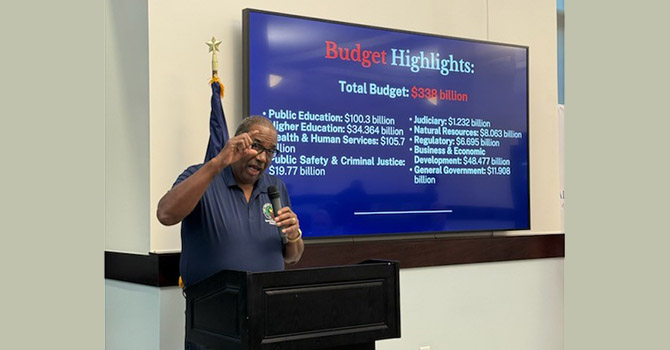
(The Dallas Examiner) – Texas recorded a $338 billion budget that was passed during the 89th legislative session for the two-year 2026-2027 calendar years. The budget will impact areas such as education, health and human services and property taxes.
State Sen. Royce West, D-23, noted that $28 million was allocated for mental health programs, $100 million for child care and $8.5 billion for education, which included pay raises for teachers and support staff.
“The majority of state spending continues to be on education, Health and Human Services, which includes all Medicaid spending,” West said during a town hall meeting he hosted June 28 at UNT Dallas College of Law on Harwood St. to address the current bills passed by the House and Senate during the 89th Texas Legislature.
Property taxes and the high cost of living for Texans was also reviewed. During the session, a $51 billion for property tax relief bill was created by raising the homestead exemption to $140,000. This bill is up for election in the upcoming November elections.
Birth registration
One of the new bills would delay birth registration.
“A lot of people were born at home with the help of midwives,” West stated. “We’ve had dozens upon dozens of constituent cases involving the need for delayed birth registration. We’re able to pass the bill this time, and this bill will allow for consideration of more evidence from persons who need a delayed birth registration that was previously unable to consider.”
One of West’s bill’s that he was able to get passed with other legislators would prevent forced bundling of insurance policies in the state.
“In the fall of 2024, my office was inundated by calls, and even one of my staffers was a victim of this where particularly an insurance company was sending homeowners insurance customers, telling them that if they didn’t bundle homeowners’ insurance and auto insurance, their home loan insurance would be canceled,” he said. “It’s not going to stop you from bundling if you want to, but you’re not going to be forced to do it now.”
Another critical bill discussed was Senate Bill 647 which deals with deeds.
“There’s a lot of deed fraud and property theft going on, not only in Texas, but around the country,” West said. “Deed fraud and title theft is when a third party not affiliated with your property goes and files, seemingly an official document indicating that property is transferred or sold to another home. This happens all the time, and the Dallas County district attorney’s office is working right now on at least 30 cases of this.”
Additionally, West discussed the need for more mental health investment in the state, especially after the Uvalde massacre.
He noted that out of the $28 million the state legislature has allocated for addressing mental health needs, some of the money will be used to help mental health professionals pay off their loans through professional loan repayment programs along with introducing pathways that allow community college students to complete master’s degrees within six years through Senate Bill 1401. The bill also explains the importance of reducing the cost of higher education and ensuring pathways for terminal degrees.
“Those eligible include licensed physicians who are certified in psychiatry, psychologists, licensed clinical social workers, licensed specialists in school and schools that deal with psychology, chemical dependency counselors,” West said.
Furthermore, in 2024, Texas college students lost almost $25 million in credit hours.
“Twenty-five million that were not counted by a four-year university, the total cost to the state and students all together exceeded $41 million,” West explained.
He focused on Senate Bill 3039 which relates to the transfer of students in public higher education and transparency regarding certificate and degree program requirements. The bill aims to improve the transfer process for students moving between institutions of higher education and to ensure clear information is available about degree and certificate requirements.
“Back when I was attending UT Arlington, I applied for all the different financial aid programs, and I ended up getting more money than I needed,” West said. “What we’ve done with this particular bill is to make sure that during an application process, the people know that if you give them the money that you get exceeds your actual need, then that money is going to be plugged back. So they don’t turn around spending that money and say, well, where we’ll get the money in order to pay back. And so that was another bill that was passed.”
Other action items West and his team focused on working with the governor were implementing technology to require ID verification for alcohol sales at grocery and convenience stores by Jan, 1, 2027.
In addition, he discussed issues related to public safety and criminal justice bills such as Senate Bill 650, which deals with preventing underage drinking and driving, and the Deshawn Jagwan Bill.
“This one will go a long way towards stopping underage drinking,” he stated. “We hope it does at least, hopefully it helps mitigate it, and underage drinking while driving. “It requires that beginning Jan. 1, 2027, grocery stores and convenience stores swipe a person’s identification to verify their age prior to the retail sale with alcohol. We don’t have the technology right now because the technology is not available. This bill was named after Deshawn Jagwan, a Woodrow Wilson High School student who, without being asked for an ID, made multiple purchases of alcohol on prom night and he died in a drunk driving crash.”
Last, West addressed foster care and kinship care.
“How many of you know someone, just a grandparent, who is taking care of their child’s children,” he asked the audience. “The problem is that they’re not having the resources to be able to do it.”
As a result, in this legislative session, $100 million was allocated for child care.
“This is a significant victory for the state,” West concluded.