

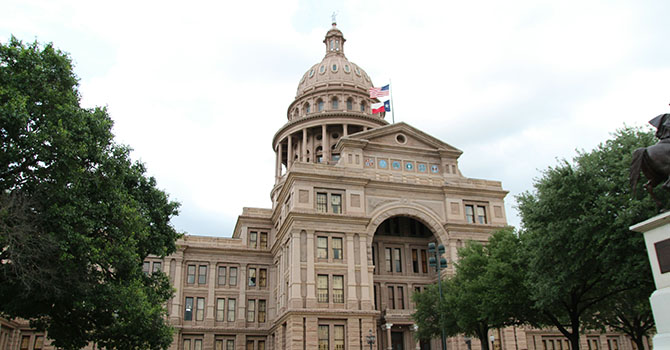
(The Texas Tribune) – Lawmakers in the Texas House and Senate filed more than a thousand pieces of legislation Nov. 19, offering an early look at the issues they hope to prioritize when they gavel in for the 89th legislative session in January.
Some of the topics covered in the first day of filing for 2025 session:
Related Stories
- Border and immigration
- Elections
- LGBTQ+ rights
- Marriage
- Criminal justice
- Energy
- Health
- Guns
- Workers’ wages
- Property taxes
- Abortion
- Public education
- Higher education
Border and immigration
Almost two dozen border and immigration-related bills filed Nov. 19 suggest some Republican lawmakers will remain bullish on those issues.
House Bill 354, filed by Rep. Briscoe Cain, R-Deer Park, would create a Texas Border Protection Unit whose officers would have the authority to arrest people who cross the Texas-Mexico border illegally – mirroring U.S. Border Patrol’s job. The unit would also oversee construction and maintenance of physical barriers, including the state’s border wall.
A similar measure failed last year but has vocal support from immigration hardliners like Texans for Strong Borders.
Senate Bill 81, filed by Sen. Bob Hall, R-Edgewood, would give the Department of Public Safety “during a state of invasion or imminent danger on the Texas-Mexico border” the authority to return to Mexico people seen entering Texas illegally or who are arrested near the border. Gov. Greg Abbott invoked the invasion clause of the U.S. and Texas constitutions in 2022 to justify the state’s ongoing border operations. The bill would also let DPS use force to “detect, repel, apprehend, detain, and arrest known transnational cartel operatives in the border region.” The bill does not give a definition of who would be considered a cartel operative.
Another bill filed by Hall – SB 134 – would require counties and cities to request and enter partnerships with Immigration and Customs Enforcement to authorize officers and employees of the municipality or county to enforce federal immigration law. The attorney general’s office could seek injunctive relief against counties and cities that do not make such requests. The partnerships – known as 287(g) agreements – could help with extra staffing to carry out the Trump administration’s ambitious immigration crackdown.
A pair of companion bills – filed in the House by Rep. Ryan Guillen, R-Rio Grande City, and in the Senate by Sen. Royce West, D-Dallas – would offer student loan repayment help for lawyers who work at least one year for the state’s border prosecution unit. The unit – created by the Legislature in 2009– is a coalition of border district attorney’s offices. The number of cases filed and prosecuted in those offices has exploded in recent years since Texas launched its multi-billion-dollar border initiative, Operation Lone Star, which has resulted in thousands of criminal trespass and human smuggling arrests.
Another bill filed that day calls for DPS to fingerprint undocumented children for a database to be used “to investigate the frequency with which a child … has entered the United States unlawfully through the international border with Mexico.”
It is unclear if the Department of Justice under Trump’s administration would contest Texas’ authority to create and enforce immigration-related state laws. President-elect Trump has said he wants to help border states like Texas.
Last year’s Senate Bill 4, which gives police the authority to arrest people suspected of having entered the country illegally, has yet to go into effect after the U.S. Justice Department sued to stop it; the legal dispute remains unresolved. The federal government argued that Texas’ law encroached on the authority of the federal government, who has been solely responsible for immigration enforcement. It is unclear whether the Trump administration will continue the lawsuit.
Elections
Earlier this year, Abbott said the state had removed more than 6,500 potential noncitizens from its voter rolls. An investigation by ProPublica, The Texas Tribune and Votebeat found that number was likely inflated and, in some cases, wrong.
Nonetheless, Republican lawmakers Rep. Briscoe Cain of Deer Park and Sen. Bryan Hughes of Mineola, filed bills that would require Texans applying to register to vote to provide proof of citizenship. Arizona is the only state in the country with such a requirement in place. Hughes proposed similar legislation last year but it did not move forward.
Rep. Valoree Swanon, R-Spring, proposed a bill that would designate certain licensed peace officers to serve as election marshals. Election marshals would have the powers and duties of state inspectors, including investigating alleged election code violations. A similar piece of legislation passed the Senate last year but was not approved by the House.
Rep. Steve Toth, R-The Woodlands, also filed a slate of bills clamping down on election security. House Bill 1001 would require poll workers to provide paper ballots to voters who request one, a measure aimed at addressing concerns that voting machines are rigged (those claims have been broadly debunked). House Bill 999 mandates that the custodian of election records shares ballots people used to cast their votes or their images with anyone who requests them for inspection within 60 days of an election.
Austin Democratic Rep. John Bucy, meanwhile, filed several pieces of legislation that would expand voter access and education. House Bill 374 would designate certain election days as state holidays, and House Bill 665 specifies information the secretary of state’s website must contain about upcoming elections.
A group of Democratic Texas senators also filed legislation directing county commissioners’ courts to designate at least one polling place on college campuses with at least 5,000 students, and at least two polling stations on college campuses with 10,000 students. One more polling place must be added to each campus for every additional 10,000 students enrolled at that college or university. The legislation comes after multiple counties across the state removed early voting locations from college campuses during the most recent election despite pushback from students.
LGBTQ+ rights
Last session, Texas Republicans passed some of the most aggressive anti-LGBTQ+ legislation in the country, outlawing gender-affirming care for minors and severely limiting drag performances.
Bills filed Nov. 19 show that Republicans plan to go even further this session. HB 847 would ban the use of any taxpayer resources for “gender reassignment” – including the funding of health benefits that cover gender reassignment for adults. The bill, filed by Rep. Brian Harrison, provides exceptions for those defined as “intersex.”
Another bill would make it a felony for public schools or universities to conduct or permit any study of children’s sexual behavior. The author of that bill, Edgewood Republican Sen. Bob Hall, also filed legislation that’d require school districts to inform parents if their child’s perception of their biological sex is “inconsistent” with their “sex organs, chromosomes and endogenous hormone profiles.” The bill would also allow parents to sue districts that fail to inform them about curriculum involving sexual orientation or gender.
Hall also filed a bill that would prohibit government health insurance programs from covering gender-affirming care and increase civil liabilities for doctors who offer transition-related medical procedures.
Another bill, filed by Rep. Steve Toth, a Republican from The Woodlands, would allow drag performers to be sued by children who attended their performances – even if the child was brought to the performance by their parents.
HB 778, filed by Rep. Jeff Leach, a Republican from McKinney, would require health insurance plans that pay for gender-affirming care to also cover the costs of any adverse consequences related to the treatment, as well as any treatments to reverse the patient’s transition.
Some Republicans seem to also want to resurrect the idea of a “bathroom bill,” legislation that would prohibit people from using a bathroom that doesn’t align with the sex they were assigned at birth. A previous attempt in 2017 died after months of controversy, but Toth and Sen. Mayes Middleton, a Republican from Galveston, have both filed bills that aim to reignite the issue.
Marriage
Rep. Cody Vasut, R-Angleton, filed two bills that would affect marriages. One of them, House Bill 732, would repeal a section of the Texas family code that allows for marriages to be annulled because of impotency.
Another Vasut bill would make Texas one of four states that allow “covenant marriage,” a legal arrangement that has been favored by some conservative Christians, including U.S. House Speaker Mike Johnson. Under House Bill 931, both parties would have to agree to a divorce in order for a court to grant it. Before that, they’d also have to undergo at least five hours of counseling by a member of the clergy or a licensed mental health professional.
Advocates for covenant marriage say it helps foster “traditional family values” and protect marriage by requiring counseling or other steps before divorce. Critics, however, say that it amounts to a government endorsement of a specific form of religious marriage, and that it can make it more difficult for spouses or families to flee abusive situations.
– Alejandro Serrano, Eleanor Klibanoff and Robert Downen/CNN contributed to this report
This article originally appeared in The Texas Tribune at https://www.texastribune.org/2024/11/12/texas-legislature-bills-filing/.
The Texas Tribune is a member-supported, nonpartisan newsroom informing and engaging Texans on state politics and policy. Learn more at texastribune.org.